
The Thai government has declared 2026 a “Golden Year” for medical tourism, with an explicit target of 5.8 million international medical travelers. Hospitals, airports, and visa policy have been reorganized around that goal. Hotels — with a few exceptions — have not.
That gap is the opportunity.
The economics
International medical travelers are not an incremental demographic. They are a structurally different guest profile. Three numbers explain why:
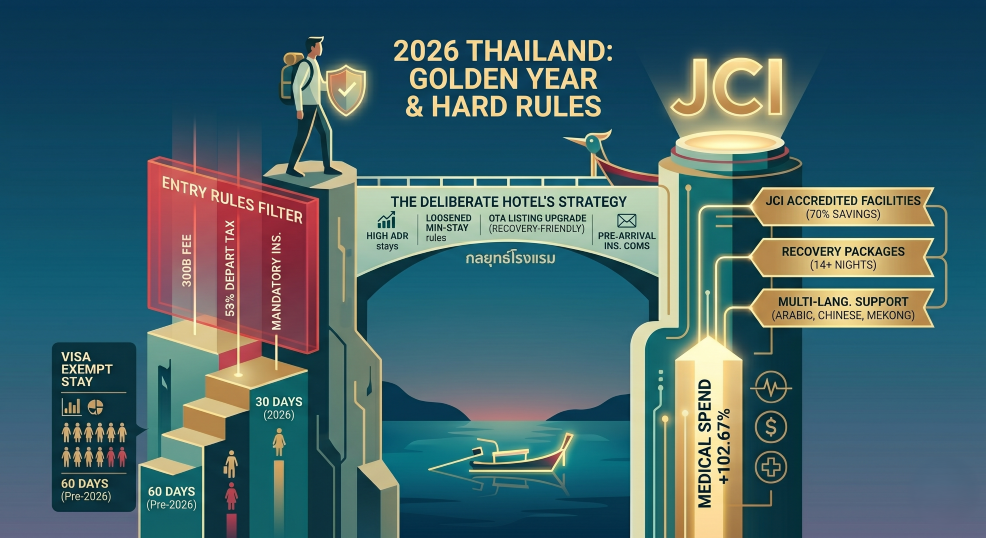
• Medical travelers to Thailand spend, on average, 102.67% more per trip than general leisure tourists — more than double.
• Treatment in Thailand runs 30–70% cheaper than equivalent care in Western markets while being delivered at JCI-accredited facilities.
• The traveler typically stays longer, requires ancillary services (transport, translation, recovery meals), and books further in advance.
Longer stays, higher spend, longer booking windows, softer rate sensitivity. From an OTA and revenue perspective, that is a very attractive guest.
Where they come from
Policy is explicitly targeting three source markets: the Middle East, China, and the Greater Mekong region. Visa facilitation and AI-powered telemedicine platforms are being positioned specifically to attract medical travelers out of these markets. If your property is within an hour of a JCI-accredited hospital — particularly in Bangkok, Phuket, Chiang Mai, or greater Pattaya — this is your adjacent market.
Why most independent hotels are invisible to this guest
Medical travelers do not book through the same discovery path as leisure travelers. They search after — or in parallel with — choosing a hospital. Discovery usually runs through a hospital concierge, an international-patient liaison, or a regional medical-tourism agency. By the time the guest lands on Agoda, the hotel shortlist has often already been shaped.
Three practical consequences for an independent hotel:
1. If you are not on the radar of a hospital concierge team, you do not exist in this channel.
2. Your OTA listing content is probably not answering the questions this guest asks. Recovery-friendly rooms? Airport transfer? Dietary options? Quiet floor?
3. Your pricing may be structured around 2–4-night leisure stays, not 7–21-night recovery stays.
Five practical moves for 2026
1. Map your nearest JCI-accredited hospitals and medical-tourism clinics.
If you do not know which hospitals refer guests into your area, start there. Bangkok Hospital, Bumrungrad, Samitivej, the Phyathai group, and major facility clusters in Phuket and Chiang Mai are the obvious anchors. Direct outreach to their international patient departments is more productive than any OTA campaign in this segment.
2. Build a medical-stay package.
A 14-night package priced below a nightly-rate equivalent is not “discounting” — it is addressing a different guest type. Include airport transfer, daily hospital transport, in-room dining, and laundry. The package converts because it removes friction.
3. Update OTA listing copy and photography.
Medical travelers scan for specific signals. If your listing has a quiet-floor room, a walk-in shower, a comfortable lounge chair for a caregiver, or blackout curtains — say so. A three-line paragraph on “recovery and long-stay comfort” in your description often outperforms a new amenity.
4. Multi-language presence.
You do not need a full translated site. An Arabic-language PDF of your rate and amenity sheet, a WeChat-reachable contact, and a clear English recovery-package page will materially expand this channel. LINE OA is one of the few platforms that Thai-market travelers, hospital staff, and Mekong-region guests all use.
5. Consider insurance and concierge signaling.
Thailand is moving toward mandatory travel insurance for inbound travelers, partly because of roughly 100 million baht in annual unpaid public-hospital bills from foreign visitors. Hotels that make it easy for a guest to understand which local providers handle emergencies, what insurance is accepted, and who their English-speaking concierge is will feel the difference in reviews and repeat bookings.
The strategic read
The “Golden Year” framing will attract a wave of operators into medical tourism packaging over the next 12 months. Most will stop at a landing page. The hotels that build actual hospital relationships — even one or two — will compound those relationships for five to ten years. That is the work this year.
Our OTA management service includes a medical-traveler channel review for clients within JCI-hospital catchment areas. If you are unsure whether this segment applies to your property, a 30-minute conversation answers the question.