
The quietest and most consequential change in Thai tourism policy for 2026 is not the 3-trillion-baht revenue target or the Golden Year medical push. It is the hardening of inbound visitor rules.
For an independent hotel, this changes how you should price, package, and communicate on OTAs — starting now.
What’s changing
Visa-exempt stay cut from 60 days to 30 days. The data behind the decision is striking: 89% of visa-exempt tourists stay only 1–3 days, and the average stay is 9 days. The 60-day exemption was delivering long-stay privileges to a cohort that does not use them — and, in some cases, was being exploited for informal residency and cross-border crime.
Entry fee under consideration. A 300-baht entry fee for air arrivals is progressing through review.
Departure tax up 53%. From 730 baht to 1,120 baht per departure.
Mandatory travel insurance coming. The government is moving toward requiring travel insurance as a condition of entry, driven by 100+ million baht of unpaid public-hospital bills per year from uninsured foreign visitors.
Take these together: Thailand is filtering for guests who plan their trip, show up insured, and pay for the privilege. The 2026 traveler is, on average, more deliberate than the 2024 traveler.
Why this matters for OTA strategy
1. Expect a shift toward shorter, higher-ADR stays.
If average stay compresses — even slightly — the revenue math changes. You earn less from length-of-stay and more from each night’s rate. OTA pricing strategies that rely on discounting the 5th, 7th, or 10th night are now optimizing for a shrinking cohort. Test pulling those discounts back and reinvesting the margin into a stronger first-night experience signal (upgrade on arrival, welcome drink, early check-in).
2. Review your minimum-stay rules.
Minimum-stay restrictions of 3+ nights become harder to fill when the market is skewed toward 2–3 night trips. Loosen these outside genuine peak windows. The wrong min-stay on Booking.com is an invisible revenue leak that takes 48 hours to identify and 48 seconds to fix.
3. Update your long-stay / monthly-rate positioning.
If you offered informal monthly rates to visa-exempt travelers, those bookings will decline. Reprice these units as 14-night packages, a wellness retreat, or a recovery stay — same room, different guest.
4. Be explicit about insurance in pre-arrival communications.
When insurance becomes a condition of entry, guests who land without it will be the guests who rebook dates or cancel. Your confirmation email should set expectations: travel insurance is recommended now and may be required. This reduces cancellation chargebacks and improves no-show rates.
5. Factor new fees into your package price, not your headline rate.
Airport transfer packages should now quietly absorb the impact of fees where competitive. A package that includes “airport transfer and all airport fees handled” reads better than a bare-room rate plus a pop-up tax at checkout.
The traveler psychology
Taken in isolation, any one of these changes is small — 300 baht here, a visa length adjustment there. The combined signal, however, is clear: Thailand is moving up the value chain. Travelers who are friction-sensitive will divert to Vietnam, the Philippines, and Indonesia. Travelers who are convenience-sensitive and spend-capable will accept the new structure and expect more in return.
Your hotel’s job is to sit cleanly on the “more in return” side of that equation — in your copy, your photography, your amenities, and your OTA pricing discipline.
What to audit this quarter
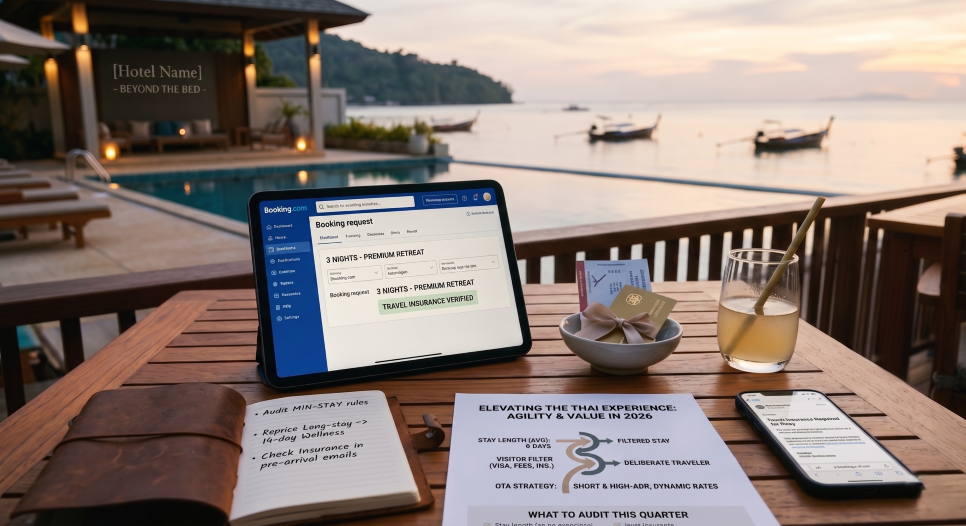
• Length-of-stay distribution on your OTA bookings vs. your minimum-stay rules.
• Discount ladders (5-night, 7-night, 10-night) — still paying off?
• Monthly / long-stay listings — still relevant?
• Confirmation-email content — does it reference travel insurance?
• Rate parity with airport-transfer packages factored in.
If any of those are overdue — and most are, in our experience — that is exactly the work our OTA management service handles for independent hotels in Thailand. The free audit surfaces the top 3–5 leaks specific to your property, typically in under 48 hours.