
In 2026, the Tourism Authority of Thailand (TAT) formally retired “recovery” as its guiding theme. The new direction — Thailand Tourism Next — reframes national strategy around a single phrase: “Value is the New Volume.”
For an independent hotel owner, this is not a marketing slogan. It is a signal about where competition, pricing, and government policy are heading over the next two to three years.
What changed
Until 2025, Thailand’s tourism playbook was clear: recover arrivals, fill rooms, return to pre-COVID baselines. That cycle is effectively complete. What follows is harder to execute — and more interesting for well-run hotels.
The government has set an ambitious 3-trillion-baht revenue target for 2026 while simultaneously accepting that arrival numbers will not be the headline. Forecasts for 2026 now range from 30–34 million international visitors — a downward revision of roughly 18% from earlier targets, with some analysts projecting arrivals as low as 28 million. Q1 2026 data already shows arrivals down 2.51% year-on-year to 9.31 million.
Put bluntly: fewer tourists, more revenue expected per tourist. The math only works if average spend per visitor — and per night — goes up.
Why this matters for independent hotels
Chains will adapt through brand-level repositioning, dynamic pricing engines, and loyalty-program pull. Independent hotels do not have those levers at the same scale. What you have is inventory, location, service, and the ability to move faster than a 300-hotel group.
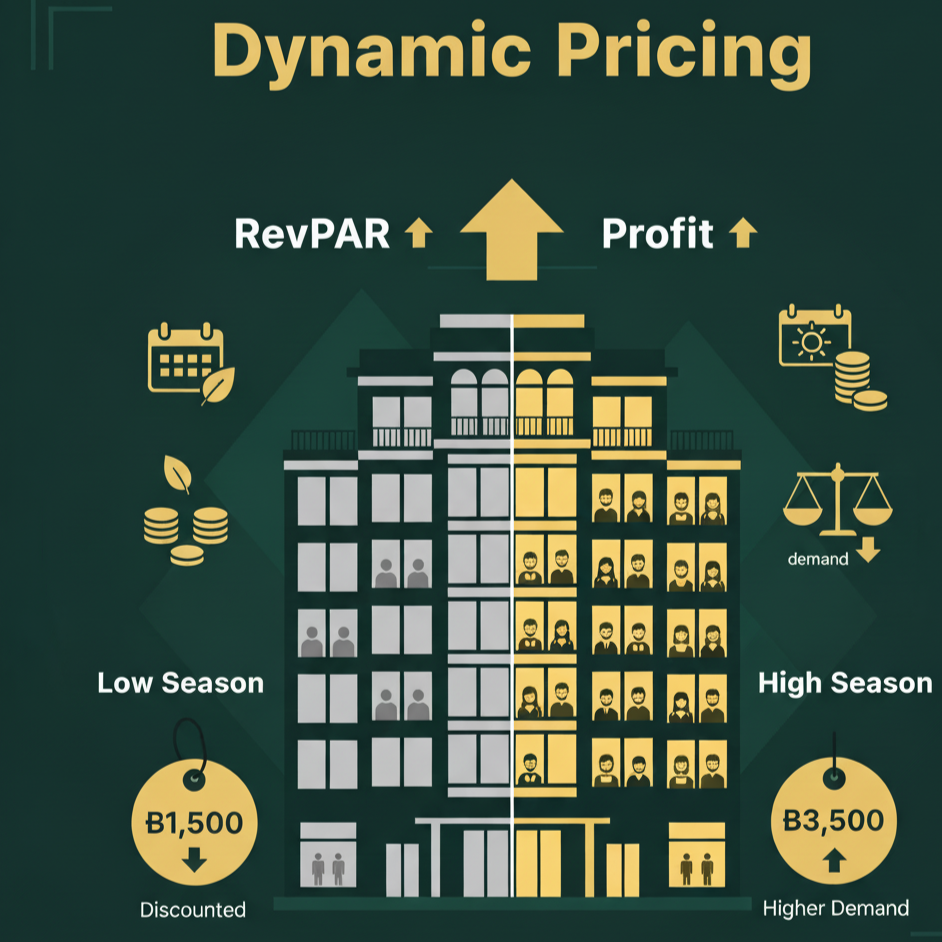
The hotels that will win under “Value is the New Volume” are the ones that stop optimizing for occupancy and start optimizing for revenue per available room (RevPAR) and, more importantly, total revenue per guest.
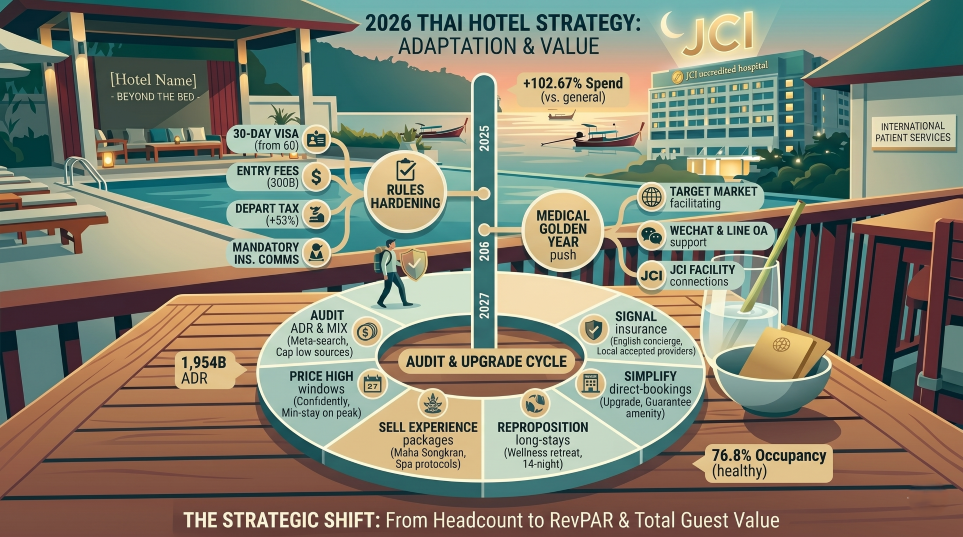
The national picture supports this. As of February 2026, average room rate is 1,954.96 baht and occupancy is 76.80% (79.34% in the South). That is healthy occupancy — so there is real room to push ADR rather than chase more headcount.
Five practical shifts to make in 2026
1. Audit ADR, not just occupancy.
If you report on occupancy each month but have not looked at ADR-versus-compset in six months, you are flying half-blind. Compare rate position on Booking.com and Agoda by day-of-week and length-of-stay. If you are consistently the cheapest in your segment while running above 80% occupancy, you are leaving money on the table.
2. Shift your OTA mix toward higher-ADR channels.
Not all OTA distribution is equal. Metasearch referrals, brand.com, and regional premium platforms tend to deliver higher-ADR guests than aggressive deal channels. Review your channel contribution to revenue (not just bookings) and consider capping low-ADR sources during high-demand windows.
3. Price with confidence during high-intent windows.
High-intent windows — Tomorrowland Thailand 2026, the Maha Songkran World Water Festival, SEA Games period — are not just occupancy drivers. They are rate-integrity events. Protect rate floors 60+ days out, and structure minimum-stay restrictions on peak dates.
4. Sell experience, not rooms.
The TAT’s “Amazing 5 Economy” framework — Life, Sub-Culture, Night, Circular, and Platform — is explicitly aimed at higher-spend traveler types. Wellness, sub-culture experiences, and soft-power touchpoints (food, design, local craft) raise average spend per stay. A hotel that packages even one distinctive experience — a spa protocol, a curated neighborhood tour, a private chef night — moves into a different pricing tier on OTA content.
5. Build direct-booking conversion, not just a direct-booking offer.
A discount alone will not shift channel mix. A direct-booking advantage that matters — early check-in, a room upgrade on arrival, a guaranteed amenity — will. Measure your direct share quarterly. If it is under 10%, that is the single highest-leverage lever you have.
The bigger read
“Value is the New Volume” is not just a TAT campaign — it is how the market is going to price itself over the next three years. Hotels still competing on headline rate alone will feel it in 2026 RevPAR. Hotels that reposition now — sharper ADR discipline, better channel mix, experience-led packaging — will come out of this cycle stronger than they entered it.
If you want to know where your hotel sits on this curve, that is exactly what our free OTA audit is designed to surface. We walk through channel mix, ADR positioning, and leakage — and tell you, bluntly, where your next 1,000–2,000 baht per room-night is hiding.